
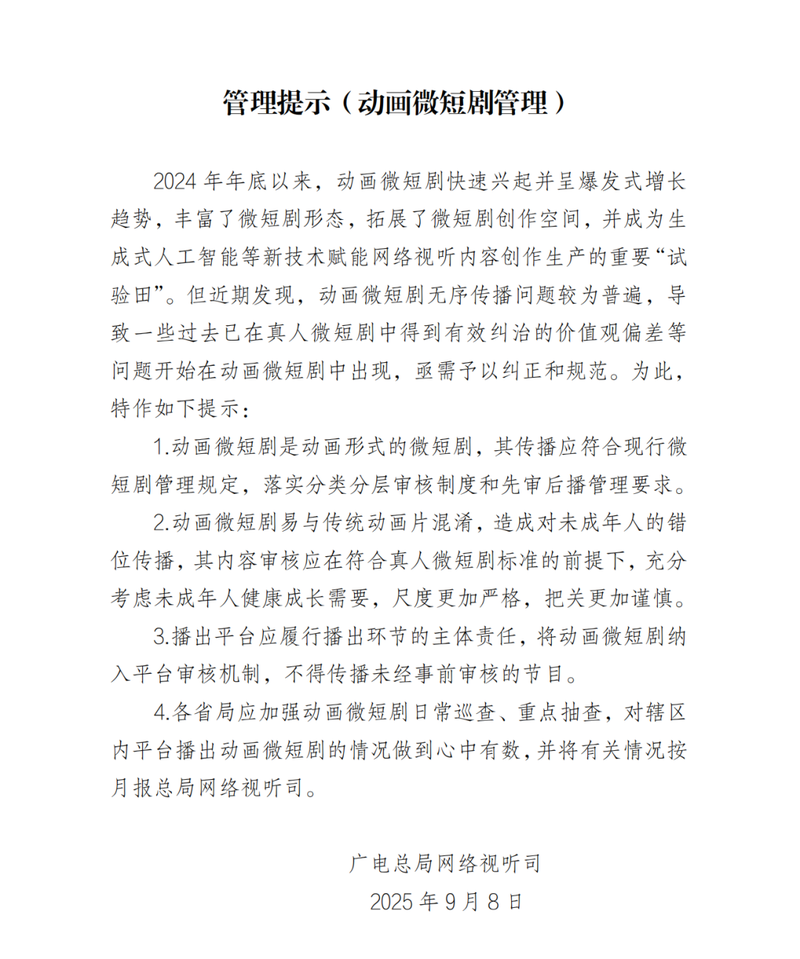
On 8 September, the Audiovisual Division of the Network of the General Directorate of Radio and Television launched the Management Alert (Animated Micro-Synthetic Management).
According to the Management Alert, the recent discovery of widespread problems with the disorderly dissemination of animated short dramas has led to the emergence of values deviations that have been effectively addressed in the human short play in the past, which need to be urgently corrected and regulated.
To this end, the following recommendations are made:
1. Animated mini-synthesis is an animated micro-synthesis, the dissemination of which should conform to the existing micro-synthetic management requirements, the implementation of a classification-level audit system and the pre-screening management requirements.
2. Animated micro-shorts can easily be confused with traditional animated films, resulting in the mistransmission of minors, whose content should be reviewed with due regard for the healthy development needs of minors, in accordance with the standards of human micro-shorts, and with greater rigour and caution.
3. The broadcast platform shall perform the primary responsibility of the broadcast chain by including animated micro-fellows in the Platform ‘ s audit mechanism, and shall not disseminate programmes that are not previously approved.
4. The provincial directorates should strengthen the daily, focused and spot-checking of the animation mini-facilities, take stock of the performance of the animation mini-facilities on the platform in the jurisdiction and report the situation to the web-based audio-visual division of the General Directorate on a monthly basis.
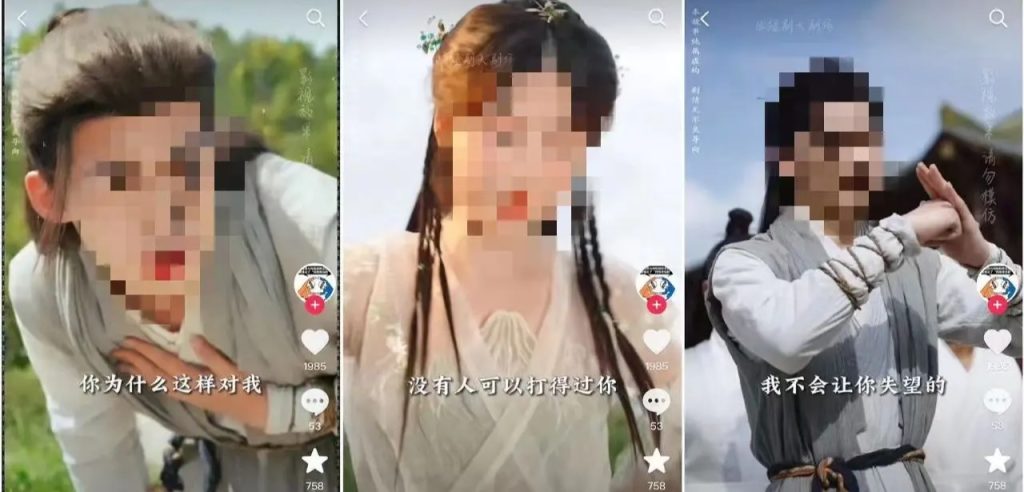
What are the dangers of animated short operas that spread in a disorderly manner? Recently, several mainstream media outlets, such as the Observatoire, have warned about such content, which involves a large amount of wiping and dark messages –
“Each time a man marries, a tooth is added to the necklace. The more teeth, the more favored females…” This is the opening of an animated short play on a short video platform. The play was based on the “Five Animals, One Woman” and the number of individual broadcasts exceeded 30 million.
During the summer, many parents discovered that short videos of their children were a secret. Parents say that they thought the child was watching animated films, but they heard adult words such as “round house” and learned, upon enquiry, that the child had been watching for a long time, repeated the lines and said they wanted to read them again.
It is understood that many of these animation shorts have been adapted from the explosive micro-short scripts or web novels and that the production threshold is extremely low. The creators need to spend a few dozen dollars on the material package so that it can be quickly produced with an AI tool and the material can be used repeatedly.
One industry has revealed that, because of the roughness of the production, such content tends to be “broad-eyed” in the drama and attracts traffic through exaggerated design. This light-asset, easy-to-operate model not only attracts a large number of individual creators, but also attempts by some companies to visualize reality and seize potential markets.
In-depth observation of various video platforms revealed that some of the animation short plays had obvious content problems. On the subject, charades like “rebirth of revenge”, “human-terrestrial love”, “mono-poo-poo-poo-poo-poo-poo-poo-poo-poo-poo-poo-poo-poo-poo-poo-poo-poo-poo-poo-poo-poo-poo-poo-poo-poo-poo-poo-poo-poo-poo-poo-poo-poo-poo-poo-poo-poo-poo-poo-poo-poo-po-po-po-poo-poo-po-po-po-po-po-po-po-po-po-po-po-po-po-po-po-po-po-po-po-po-po-po-po-po-po-po-po-po-po-po-po-po-po-po-po-po-po-po-po-po-po-po-po-po-o-po-po
Even more worrying is the fact that many of the works contain tendencies such as school bullying and dark terror: Some stories repeat the strange story of an 18-year-old girl who was thrown into a snake pit to lay her eggs, while others show the extreme solution of a person with mental illness who “does violence” in the name of “school bullying revenge”.
It is alarming to note that the group of young people is an important user of micro-short plays, and that animated short plays are very easily “targeting content” for minors with “animated” clothes. Although most platforms have a “youth model”, parents generally reflect that the above-mentioned “toxic” animated shorts can still use the “child-like content” label to enter the recommended pool.
Yaohua, Director of the Institute of Sociology, Guangxi Institute of Social Sciences, noted that animated films were usually regarded as child-friendly products, but that such animated shorts were adult-oriented narratives. Incidents such as “overall revenge” and “hommen murmuring” circumvent the content review in animated packaging, which, although not explicitly targeted at children, lowers the identification threshold and increases exponentially the impact of values deviations once they enter the child’s perspective.
This “toxic” animated shorts seem to be fresh and distorted. Its narrative structure and language expression are increasingly aligned with adult logic, leaving children prematurely exposed to complex topics such as “power” and “wealth” and not conducive to the shaping of a healthy world view. These “generic cults” in the child’s garbs are undermining children’s emotional ecology and cognitive approaches.
Young people are at a critical stage in their rapid physical and mental development and in the formation of values, as well as in the transition to a micro-short play market, which is led by quality and value.The harm is immeasurable if this “distortional cult” that encourages the development of emotional ecology and cognitive patterns that are so easily eroded by children is allowed to develop.
On 8 September, a management note issued by the Audiovisual Division of the Network of the General Directorate of Radio and Television was placed on the seven inches of this irregular animation.
First, the implementation of the classification stratification system and the pre-screening management requirement are equally applicable to animation-type micro-shorts, clearing the area of ambiguity; secondly, taking into account the healthy growth needs of minors, the introduction of a more stringent vetting mechanism will be effective in avoiding the emergence of “toxic” content; and then, after increased inspections and spot-checking in the relevant departments, there is no opportunity for the leaking fish to be protected from micro-dubling.
Among them, as the main channel of communication, the primary responsibility for the broadcast platform has also been re-emphasized and there is an urgent need to move away from the “flow-up” short-sighted thinking. At present, the “adolescent model” alone is far from sufficient and should be accompanied by enhanced technical screening and manual review. The mandatory age markers for content, prominent alerts, open channels for reporting and improved response mechanisms are all relevant. There is a price to pay for the platform to ignore moral law for “flow”.